Organic Baby Food in Mauritius: What the Labels Actually Guarantee
10 July 2026 · By Pregnancy.mu
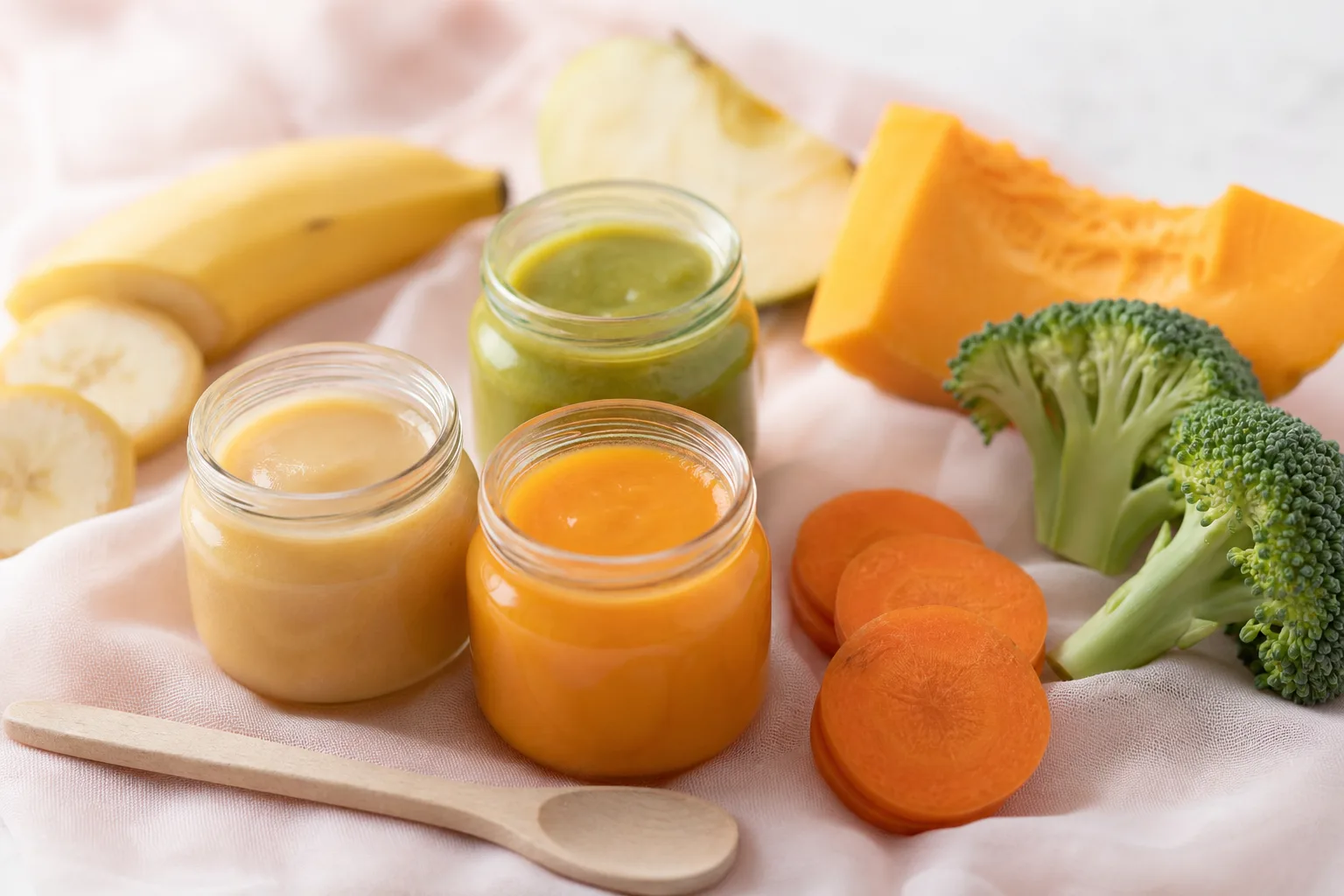
Walk down the baby aisle in almost any Mauritian supermarket and you will find the word "bio" printed on pouches, jars and boxes of infant cereal. Some of those products are genuinely certified organic, audited every year by independent inspectors. Others are simply using a word that, in Mauritius, no law currently protects. If you are starting solids and trying to make careful choices for your baby, that difference matters far more than the packaging lets on.
This guide explains what organic certification actually guarantees on baby food, and which marks to look for. It is general information, not medical advice. For anything specific to your baby, including weaning timing, allergies or special dietary needs, always speak to your paediatrician.
Why babies are the strongest case for organic
If there is one group for whom the organic question deserves serious attention, it is infants. The reasoning starts with simple arithmetic. A six month old eating a bowl of fruit puree consumes far more food per kilogram of body weight than an adult eating the same bowl, so whatever residues that food carries, the baby receives a proportionally larger dose.
Research also suggests that infants may be more sensitive to pesticide residues than adults, because their organs, immune systems and nervous systems are still developing. Weaning diets are also narrow by design. A baby may eat the same handful of foods, apple, carrot, rice, pear, day after day for weeks, which concentrates exposure to whatever those particular crops carry.
None of this means conventional baby food is dangerous. Legal residue limits exist precisely to protect consumers, and infant foods sold under European rules are held to especially strict ones. But it does explain why many nutrition-minded parents treat the first two years as the window where organic makes the most sense, a case explored in more depth in this plain-language overview of why organic matters most for young children.
What EU organic baby food standards actually require
European baby food sits under two separate layers of regulation, and it helps to understand both.
The first layer applies to all infant food, organic or not. EU legislation on foods for infants and young children sets pesticide residue limits that are commonly described as among the strictest in food law, along with rules on contaminants, composition and labelling. Any European jar or pouch aimed at babies has already cleared this bar before the word organic even enters the conversation.
The second layer is organic certification itself. To carry the EU organic logo, at least 95 percent of a product's agricultural ingredients must come from certified organic farming, which prohibits synthetic pesticides and fertilisers in cultivation and bans genetically modified ingredients. Producers are inspected at least once a year by an accredited certification body, and every ingredient must be traceable back through the supply chain.
France has been the heartland of organic infant nutrition for decades. Babybio, produced near Bordeaux by the family company Vitagermine, is widely regarded as one of Europe's organic baby food pioneers, and brands with that kind of heritage operate under both layers at once: infant food law and annual organic audits. When you see those jars on a Mauritian shelf, the guarantees printed on them were earned inside that system, not on the island.
Decoding the marks: AB and the Eurofeuille
Two logos do most of the heavy lifting on European organic baby food.
The Eurofeuille is the green rectangle with a leaf drawn in white stars. It is mandatory on prepacked organic food produced in the EU, and it is the mark with legal force. Underneath it you should always find two things: the code of the certification body that audited the product, in a format such as FR-BIO-01, and a statement of where the agricultural ingredients were farmed. If a product claims to be organic but carries no certifier code, treat the claim with caution.
The AB mark, short for Agriculture Biologique, is the older French national logo. It is now voluntary and follows the same underlying European rules, but French brands keep printing it because generations of shoppers recognise it instantly. Seeing AB alongside the Eurofeuille tells you the product lives inside the French organic system.
It is just as important to know what these marks do not promise. Organic certification is a guarantee about farming and processing methods, verified through inspections and paperwork. It is not a laboratory promise of zero residues, and it says nothing about whether one puree is more nutritious than another. Composition rules for baby food come from the separate infant food legislation mentioned above, whether the product is organic or not.
The Mauritius gap: "bio" is not a protected word here
Here is the uncomfortable part. At the time of writing, Mauritius does not enforce a legal definition of organic on food labels the way the EU does. No local scheme can penalise a producer for printing "bio" or "natural" on a package that would never pass an organic audit. Many local producers are sincere, but the word alone guarantees nothing.
The practical consequence for parents is straightforward: on Mauritian shelves, the trustworthy signal is the imported certification mark plus its certifier code, not the word bio itself. If you want to get comfortable reading those marks quickly, this walkthrough of the certification logos you will actually see in Mauritius covers the European and other international marks in plain language.
A practical organic starter list
You do not need to buy everything organic to make a meaningful difference. A commonly recommended approach is to prioritise the foods your baby eats most often and in the largest quantities:
- Infant cereals and grains such as rice and oats, since these are often the very first foods and are eaten daily
- Everyday fruit purees, especially apple and pear, which tend to appear in large amounts week after week
- The vegetables in heaviest rotation in your weaning plan, often carrot, pumpkin and sweet potato
- Plain full-fat yoghurt and other dairy, once your paediatrician confirms your baby is ready for it
- Ready-made pouches and jars, where choosing the Eurofeuille means the whole recipe was audited, not just one ingredient
For foods your baby eats rarely or in tiny amounts, the organic question matters much less. Washing and peeling conventional produce also remains a sensible habit whichever route you take.
Finding certified organic baby food in Mauritius
Availability is improving. Pharmacies and the larger supermarkets stock a rotating selection of certified European brands, and a dedicated option is arriving: Naturespan, a new certified organic grocery destination, opens stores in Grand Baie and Tamarin from 1 September 2026, with its food truck already on the road around the island. Its certified organic baby food range is built around brands that carry the Eurofeuille with visible certifier codes, which takes the label-reading homework off your plate.
Wherever you shop, the habit to build is the same: turn the jar around, find the leaf, find the code.
The honest bottom line
Organic certification is a genuine, audited guarantee about how food was grown and made. For babies, whose small bodies and narrow diets make them the strongest case for it, that guarantee is worth understanding. But it is one tool among many. A varied diet, iron-rich foods from around six months, and relaxed, responsive feeding will always matter more than any single logo, and those are conversations to have with your own health professionals.
If budget or availability forces choices, choose calm over perfection. A baby enjoying a varied conventional diet is a well-fed baby. Organic, where you can find the certified real thing, is a careful extra step, and now you know exactly what the labels do and do not promise.
A healthy pregnancy is the start of a longer, healthier life. Explore the wider Healthspan health ecosystem.